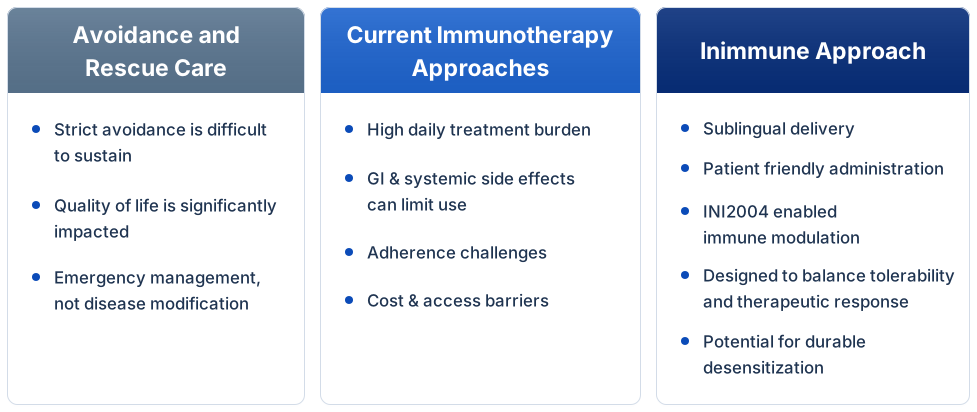
Inimmune is advancing a next generation mucosal immunotherapy approach for food allergy, enabled by INI-2004, a next-generation TLR4 agonist, and our proprietary mucoadhesive formulation technology. Through stimulation of TLR4, INI-2004 primes the immune system to mount a Th1-biased, non-allergic response to allergens encountered in the environment, preventing the allergic response cascade from being initiated, regardless of the allergen of interest. These new signals change the type of immune memory that is generated in response to the allergen(s), resulting in durable disease protection. Built to scale beyond peanut allergy, Inimmune has developed a flexible mucosal formulation that supports multiple food allergens, enabling rapid, broad-spectrum pipeline expansion. After we establish safety of sublingual INI-2004 and proof of concept efficacy data in peanut allergic patients, we plan to continue development in peanut allergy and broaden the use of sublingual INI-2004 into other food allergy indications, such as tree nut, milk, egg, soy, and shellfish.
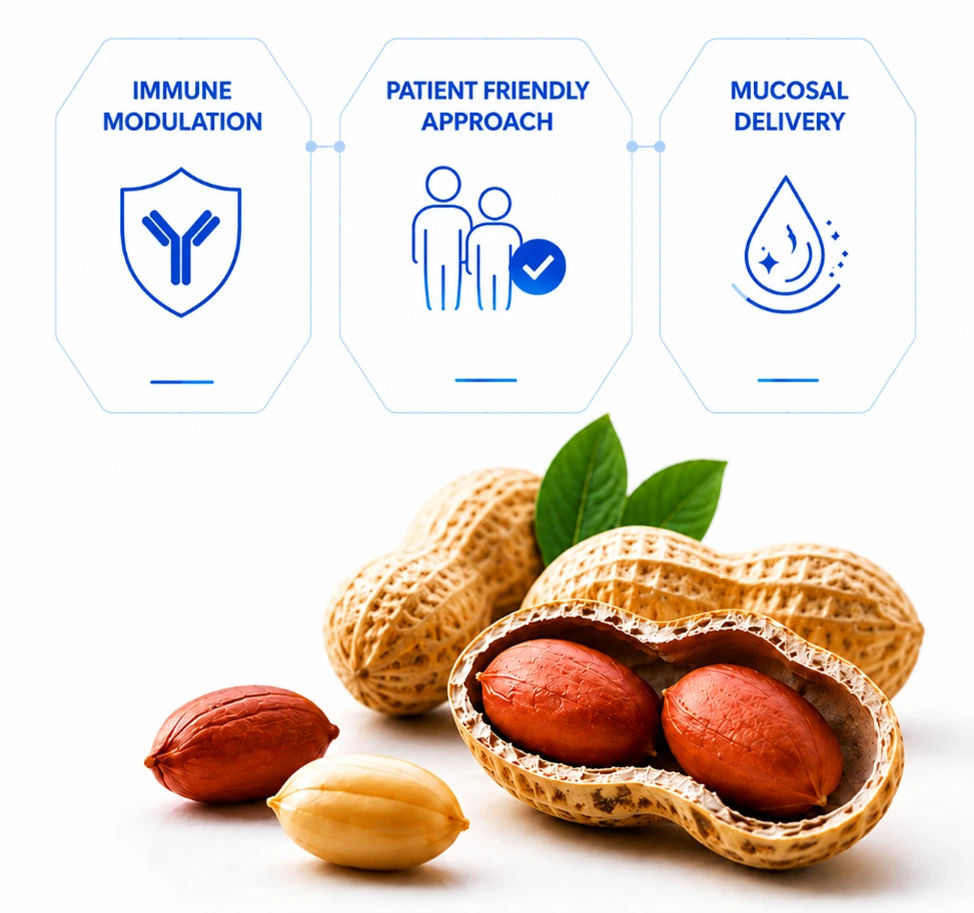
Peanut allergy is one of the most common and persistent food allergies, affecting approximately 1 in 13 children and 1 in 10 adults with food allergy related conditions. Diagnosed food allergy cases across major markets are projected to reach 44.3 million by 2034, highlighting a massive, urgent need for practical and disease-modifying therapeutic options.
Despite advances in treatment, patients continue to face difficult trade-offs between efficacy, safety, treatment burden, and long-term adherence. Inimmune is addressing this gap with a differentiated approach that integrates targeted immune modulation, engineered mucosal delivery, and patient-friendly sublingual administration to enable faster and durable allergen desensitization. Peanut is our lead indication, and the first step toward a broader platform designed to address multiple food allergies. Inimmune is advancing the program toward a planned Phase 1 peanut allergy study in 2027.
Despite advances in treatment, patients continue to face difficult trade-offs between efficacy, safety, treatment burden, and long-term adherence. Inimmune is addressing this gap with a differentiated approach that integrates targeted immune modulation, engineered mucosal delivery, and patient-friendly sublingual administration. Peanut is our lead indication, and the first step toward a broader platform designed to address multiple food allergies. Inimmune is advancing the program toward a planned Phase 1 peanut allergy study in 2027.
Treatment burden, tolerability, and long term adherence remain important challenges in food allergy immunotherapy. To address these limitations, Inimmune is advancing INI-2004 as a mucosal immunotherapy for peanut allergy delivered in our proprietary mucoadhesive formulation technology.