
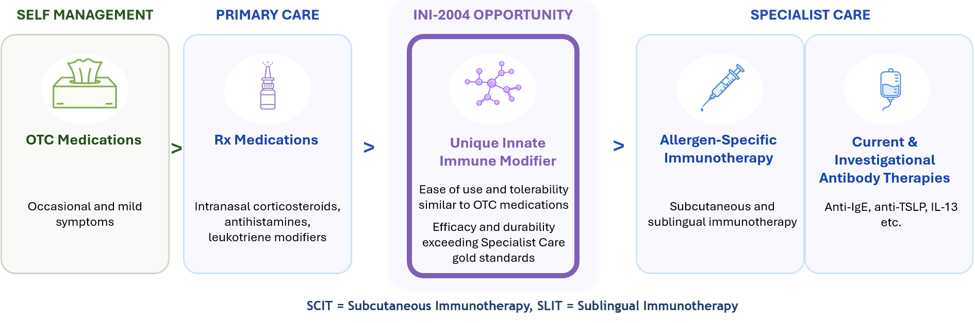
INI-2004 is uniquely positioned prior to existing gold standard immunotherapies and new competitor entrants.
Because of the ease of use of an intranasal product, INI-2004 reduces the reliance on allergen-specific diagnosis and expensive, inconvenient specialist therapies.

Intranasal INI-2004 has been tested in Phase 1 and Phase 2 clinical studies as an intranasal treatment for ragweed allergy, a common seasonal allergen. In both Phase 1 and Phase 2 studies, INI-2004 was safe and well tolerated, with an adverse event (AE) profile indistinguishable from that of placebo. INI-2004 was also undetectable in circulation, indicating that it remains local after intranasal administration.
In a Phase 1 study, ragweed-allergic subjects who were treated with INI-2004 experienced an increased improvement in total nasal symptom scores (TNSS, a commonly used and FDA recognized measure of patients’ allergy symptoms) compared to patients who were treated with placebo. This study also demonstrated that patients also experienced fewer allergy symptoms when they were exposed to ragweed 16 days after their last INI-2004 administration, demonstrating longer term effectiveness of INI-2004 and potential disease-modifying effects.
In a Phase 2 study, moderate to severe ragweed-allergic subjects were exposed to high levels of ragweed pollen in an environmental exposure chamber study after they were treated with intranasal INI-2004 or placebo. This study was completed in May of 2026 and topline data will be available in early June.
Successful completion of a chamber study using intranasal INI-2004 will lead to a first-in-class, rapid, disease-modifying treatment that may be used for any allergen, potentially changing how allergies are treated worldwide. To learn more about our clinical trials, please visit NCT06038279 for our Phase 1 trial and NCT07556393 for our Phase 2 trial.
Perennial allergies, or year-round allergies, are generally caused by indoor allergens that people are exposed to continuously, such as house dust mite and pet dander. About 80% of allergy sufferers experience perennial symptoms, with half experiencing perennial symptoms only and the other half experiencing both perennial and seasonal disease effects. Perennial allergies generate symptoms via the same immune mechanisms as seasonal allergies. Intranasal INI-2004 can therefore modify the immune response to perennial allergies via environmental exposure through the same mechanism as that of seasonal allergies. Inimmune is planning a Phase 2 clinical trial for perennial allergies beginning in mid-2027, where we will demonstrate the efficacy of intranasal INI-2004 against inhaled perennial allergens.


Asthma is a chronic respiratory disease affecting more than 300 million people worldwide and represents a major and growing healthcare burden. Allergic asthma represents the most common asthma phenotype, with allergic mechanisms implicated in approximately 80% of pediatric and 40-50% of adult asthma cases. Similar to allergic rhinitis, allergic asthma is driven by hypersensitive immune responses to environmental allergens, such as pollen, pet dander, and mold spores. While allergic rhinitis affects the upper respiratory tract, allergic asthma involves inflammation of the lower airways, where allergen exposure can trigger or exacerbate asthma symptoms and attacks. Both allergic rhinitis and allergic asthma are driven predominantly by type 2 immune responses. A key feature underlying the therapeutic success of INI-2004 in treating allergic rhinitis is its ability to reprogram the immune response to a Th1-biased non-allergic response. Given the substantial overlap in underlying immune mechanisms of allergic asthma and allergic rhinitis, we will evaluate the efficacy of INI-2004 in reducing allergic asthma exacerbations in a Phase 2 clinical trial beginning in late 2027.
