
Allergic disease, including allergic rhinitis, allergic asthma, and food allergies, is one of the most prevalent chronic diseases worldwide. Approximately 10-30% of the global population is affected by allergic rhinitis. That population continues to grow, with the fastest growth seen in industrialized nations. Food allergies are also on the rise, with a 50% increase in pediatric food allergies since 2007. Here, severe outcomes are more common, with food allergy-related anaphylaxis driving approximately one ER visit every 10 seconds in the US alone. Despite the prevalence and severity of allergic disease, allergy patients have few effective treatment options available to them, none of which offer rapid, disease-modifying efficacy.
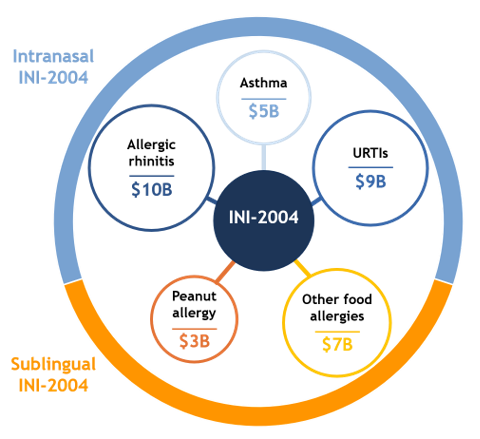
INI-2004 is an allergen agnostic immunotherapy that binds and activates toll-like receptor 4 (TLR4), reprogramming the immune response to environmental allergens and providing an efficacious, rapid, and easy to use disease-modifying therapy to patients. INI-2004 is delivered directly to mucosal tissues, either intranasal or sublingual, offering patient-friendly, needle-free, and localized drug administration.
Current allergy treatments offer limited efficacy, and the vast majority are not disease-modifying and primarily offer short-term relief from allergy symptoms. The only disease modifying therapy which is currently available to patients is allergen specific immunotherapy (AIT). AIT is a targeted treatment consisting of a small amount of allergen extract injected subcutaneously, administered sublingually, or delivered orally over the course of a few years. AIT requires long-term commitment (3 to 5 years), resulting in low patient adherence and high patient costs.
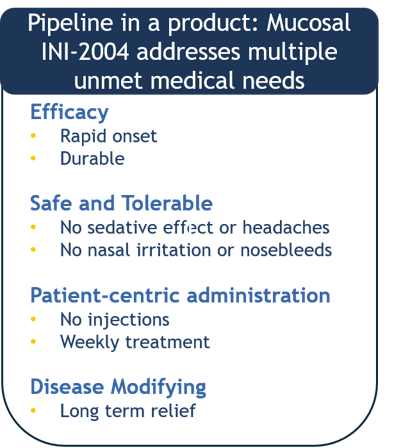
At Inimmune, we’re developing a rapid disease-modifying treatment for allergies which does not require identification of the allergen. INI-2004 binds and activates TLR4 on antigen presenting cells (APCs), which are the immune system’s first line of defense against pathogens and environmental allergens. When this happens, APCs are primed to mount a Th1-biased, non-allergic response to allergens encountered in the environment, preventing the allergic response cascade from being initiated. Additionally, these new signals change the type of immune memory that is generated in response to the allergen(s), resulting in durable disease protection. INI-2004 is being developed for seasonal allergic rhinitis (Phase 2), perennial allergies (Phase 1), allergic asthma (Phase 1), and food allergies (pre-clinical).
